On this page 11 sections
- How we chose these Fluke testers
- Comparison table
- Our Top Picks Reviewed
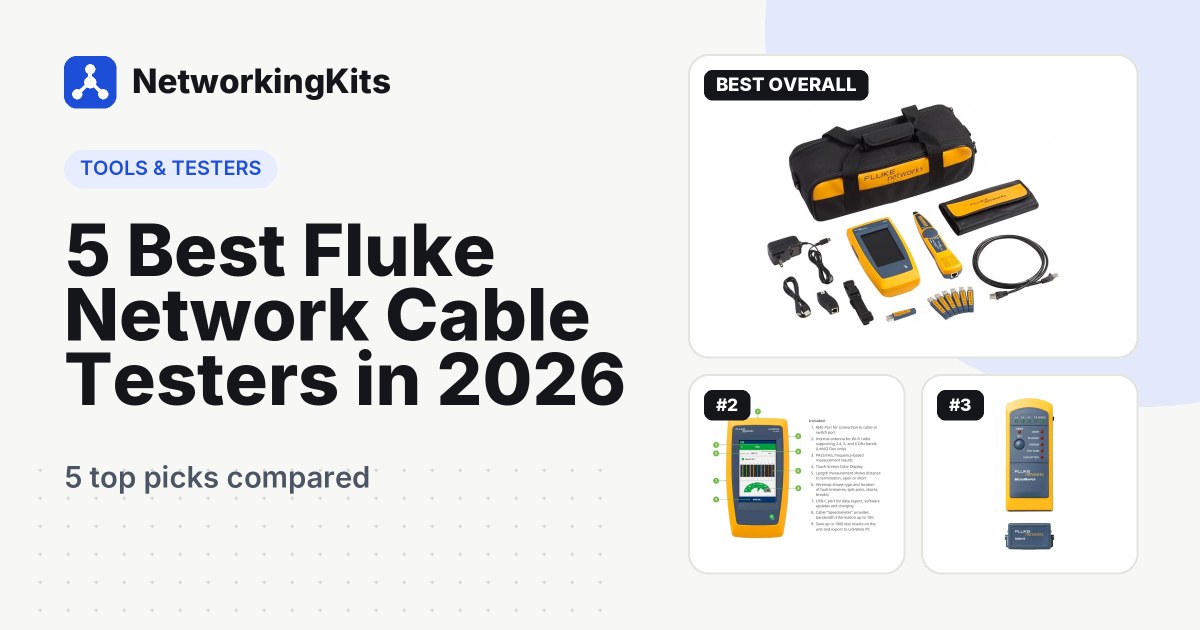
- 1. Fluke Networks LinkIQ Cable + Network Tester Kit
- 2. Fluke Networks LinkIQ-Duo Cable, Wi-Fi and Network Tester Kit
- 3. Fluke Networks MT-8200-49A MicroMapper
- 4. Fluke Networks MS2-KIT MicroScanner2 Cable Verifier Kit
- 5. Fluke Networks LIQ-100 LinkIQ Cable + Network Tester
- Buying guide: picking the right Fluke cable tester
- Final verdict
- FAQ
Every cable installer has a story about the run that looked perfect. The jack was neat, the link light came on, and the camera at the far end still dropped offline twice a day. The fix took ten minutes. Finding it took the whole afternoon.
That is the job a good tester does. It turns "something is wrong out there" into a specific answer: a split pair, an open at 42 feet, or a switch port that cannot deliver the PoE it promised. Fluke Networks has made the tools pros reach for since long before most of us ran our first cable. Its lineup is wide, though. Buy too basic and you are still guessing. Buy too advanced and you pay for reports nobody asked for.
We compared the Fluke Networks testers sold on Amazon.com and kept the ones with a strong track record among owners. Then we read what installers, IT teams and the occasional determined homeowner say after real jobs. Five made the cut, and each comes with Fluke's 1-year warranty.
Quick answer: The Fluke Networks LinkIQ Kit is the one most pros should buy. It qualifies cable up to 10 Gigabit, locates faults, reads the nearest switch and load-tests PoE, all from one handheld. If your work includes Wi-Fi access points, the LinkIQ-Duo handles that side too. For simple, trustworthy wiremap checks, the MicroMapper is the most affordable way to put a Fluke in your bag.
Only making the odd patch cable at home? A Fluke may be more tester than you need. One of our budget-friendly networking tool kits with a basic tester will cover it.
How we chose these Fluke testers
A wiremap tester and a qualifier do very different jobs, so we judged each one against its own purpose:
- What it can actually prove. Connected wires, cable length, fault location, supported speed and live network details. We noted exactly where each tester stops.
- Time saved per job. Remote IDs, distance to fault and switch readouts all cut down on the walking that eats an install day.
- Owner feedback over time. We looked for the praise and complaints that keep coming back, especially about reliability.
- Who it suits. A contractor's daily driver can be wasted money for a homeowner, so each pick has a clear owner in mind.
- Warranty. Fluke Networks covers each tester here for 1 year from purchase, and sells optional support plans for longer cover.
Best Fluke Network Cable Testers Compared (2026)
| Product | Type | Speed check | PoE test | Warranty | Score | |
|---|---|---|---|---|---|---|
 Best OverallFluke Networks LinkIQ Cable + Network Tester KitInstallers and IT teams who need cable, switch and PoE answers in one tool | Cable + network qualifier | Up to 10GBASE-T | Class 0-8 with load test | 1 year | 9.3 | Check Price |
 Best for Wi-Fi + CableFluke Networks LinkIQ-Duo Cable, Wi-Fi and Network Tester KitInstallers who test cable, PoE and Wi-Fi access points in one visit | Cable + Wi-Fi + network qualifier | Up to 10GBASE-T | Class 0-8 with load test | 1 year | 9.1 | Check Price |
 Best BudgetFluke Networks MT-8200-49A MicroMapperHomeowners and small offices that need trusted wiremap checks | Wiremap verifier | No | No | 1 year | 8.6 | Check Price |
 Best for Mixed CablingFluke Networks MS2-KIT MicroScanner2 Cable Verifier KitTechs who test Ethernet, phone and coax lines | Graphical cable verifier | Detects 10/100/1000 ports | Detects 802.3af, no load test | 1 year | 8.2 | Check Price |
 LinkIQ Without the ExtrasFluke Networks LIQ-100 LinkIQ Cable + Network TesterPros who already own a tone probe and remote IDs | Cable + network qualifier | Up to 10GBASE-T | Class 0-8 with load test | 1 year | 8.1 | Check Price |
Our Top Picks Reviewed
Here is a closer look at all 5 of our picks for the best Fluke network cable testers: what each one does well, where it falls short and who it suits best, based on the specs and real buyer feedback.

Fluke Networks LinkIQ Cable + Network Tester Kit
- Type
- Cable + network qualifier
- Tests
- Wiremap, length, distance to fault
- Speed check
- Up to 10GBASE-T
- PoE test
- Class 0-8 with load test
- In the box
- IntelliTone Pro 200 probe, remote IDs 1-7, bag
- Warranty
- 1 year
This is the tester we would hand a low voltage contractor on day one. The LinkIQ Kit answers the two questions almost every service call comes down to: is the cable good, and is the network on the other end behaving?
Start with the cable. Instead of just confirming that eight wires connect, LinkIQ uses frequency-based measurements to show whether a run can carry 1, 2.5, 5 or 10 Gigabit. It also shows wiremap, length and the distance to an open or short. That turns "bad somewhere in the ceiling" into "the fault is about 40 feet from this end".

Plug it into a live port and it changes roles. You see the nearest switch name, port number, VLAN and advertised speeds, plus IPv4 or IPv6 ping results. PoE testing is the feature owners mention most. LinkIQ is Ethernet Alliance certified, reads the power class the switch offers from Class 0 to 8, then applies a real load to prove it. When a camera keeps rebooting, that test settles the argument fast.
The kit is the version to get. Alongside the tester and its standard remote, it adds an IntelliTone Pro 200 probe, remote IDs 2 through 7 and a carry bag. Results save to LinkWare PC, so you can hand a client a tidy report.
Owners are clearly happy. Reliability and accuracy are the themes that come up again and again, and both working pros and serious DIYers say it suits them well.
Two things to know before you buy. Its own network link runs at up to 1 Gigabit, so on a multi-gig switch it reports what the port advertises rather than pushing multi-gig traffic. It is also a qualifier, not a certifier, so it cannot replace a DSX when a manufacturer warranty needs certification reports. Fluke covers it for 1 year.
Who it is for: contractors, IT teams and MSPs who test cable every week and want one tool for "is it the cable?" and "why is this device offline?".
What we like
- Qualifies cable up to 10 Gigabit, not just continuity
- Shows switch name, port, VLAN and advertised speed
- Real PoE load test up to Class 8 (90W)
- Kit adds an IntelliTone probe and remote IDs 2-7
Good to know
- A big investment, so compare Amazon sellers first
- Its own link runs at 1 Gigabit, which is fine for qualifying and switch checks
- Not a certifier, so warranty-backed projects still need a DSX

Fluke Networks LinkIQ-Duo Cable, Wi-Fi and Network Tester Kit
- Type
- Cable + Wi-Fi + network qualifier
- Tests
- Wiremap, distance to fault, toning
- Speed check
- Up to 10GBASE-T
- PoE test
- Class 0-8 with load test
- In the box
- Tester, remote ID, carry case
- Warranty
- 1 year
What do you do when the cable passes and the Wi-Fi is still slow? That is the gap the LinkIQ-Duo was built to close. It keeps everything the standard LinkIQ does on copper and adds Wi-Fi tools for 2.4, 5 and 6 GHz, up to Wi-Fi 6E.
On a modern install the two jobs are tangled together. The run you just tested probably feeds an access point, and plenty of "network problems" turn out to be crowded channels or a weak signal. With the Duo you can see the networks nearby, the channels they use and which access points are broadcasting. Then you can test a real connection from the same handheld.

The copper side is pure LinkIQ. You get performance qualification up to 10GBASE-T, wiremap, distance to fault and nearest switch details. The certified PoE test is the same too, detecting Class 0 to 8 and load-testing the power. Results appear as graphics on a large color touchscreen, so they are quick to read even if testing cable is only part of your day.
The honest caveat is age. The Duo is new, so there is only a little owner feedback to go on so far. The early impressions are positive, but that is a promising start rather than a long track record. We are comfortable recommending it because it sits on the proven LinkIQ platform, and we will keep an eye on the reviews as more installers use it.
Fluke gives it the same 1-year warranty as the other testers here, with optional support plans if you want longer cover.
Who it is for: installers and IT teams who mount access points as well as run cable. If you never touch Wi-Fi, the standard LinkIQ Kit does the copper work for less.
What we like
- All of LinkIQ's copper and PoE testing
- Wi-Fi analysis on 2.4, 5 and 6 GHz up to Wi-Fi 6E
- Large color touchscreen with graphical results
- Built on the proven LinkIQ platform
Good to know
- Very new, so owner feedback is still limited
- Costs more than the standard LinkIQ
- The Wi-Fi tools only pay off if you work on wireless too

Fluke Networks MT-8200-49A MicroMapper
- Type
- Wiremap verifier
- Tests
- Opens, shorts, crossed, reversed, split pairs
- Speed check
- No
- PoE test
- No
- In the box
- Tester, remote identifier
- Warranty
- 1 year
The cheapest Fluke on this list catches a fault that plenty of no-name testers miss. The MicroMapper flags split pairs, the wiring mistake that passes a basic continuity check and then quietly ruins a cable's performance.
Beyond that, it keeps things simple. Connect the tester at one end and the remote identifier at the other, then press TEST. The LED panel reports opens, shorts, crossed pairs, reversed pairs and split pairs. The remote stores on the tester when you are done, so one person can work alone. There is also a built-in tone generator that works with an analog probe for tracing cables through walls.

Owners like it for exactly that simplicity. The comments you see most say it does what Fluke promises and is easy to pick up. Durability is the mixed point. Most owners have no complaints. Keep the receipt for the 1-year warranty, just in case. Some also feel it costs more than generic testers that run similar checks.
What you give up is detail. There is no screen, no cable length and no distance to fault. The MicroMapper tells you something is wrong and which wires are involved, but not where along the run the problem sits. For home networks and small offices, that is usually all you need.
Wiring your own wall jacks? Pair it with our guide to punching down a keystone jack and check each one as you go.
Who it is for: homeowners, small business IT and anyone building a first tool bag who wants the Fluke name without paying for features they will never use.
What we like
- Catches split pairs that cheap testers miss
- Clear, easy-to-read LED fault display
- Built-in tone generator for tracing cables
- Most affordable Fluke tester
Good to know
- No screen, length or distance to fault (LinkIQ adds those)
- A few early failures reported, so keep the receipt
- Costs more than generic LED testers, but catches more

Fluke Networks MS2-KIT MicroScanner2 Cable Verifier Kit
- Type
- Graphical cable verifier
- Tests
- Wiremap, length, distance to fault, cable ID
- Speed check
- Detects 10/100/1000 ports
- PoE test
- Detects 802.3af, no load test
- In the box
- IntelliTone Pro 200 probe, remote IDs
- Warranty
- 1 year
Walk into an older building and the wall jacks rarely tell the truth about what is behind them. One is Ethernet, the next is a phone line, and the coax in the corner could go anywhere. That is the kind of job the MicroScanner2 Kit still handles well.
Its graphical screen puts wiremap, pair lengths, cable ID and distance to fault on one display. Instead of a red light, you see that pin 3 is open about 60 feet down the run. It measures runs up to 1,500 feet and tests twisted pair through RJ45 or RJ11 plugs, plus coax through an F connector.

Plug it into a live jack and it tells you what is on the other end. It detects 10/100/1000 Ethernet ports and 802.3af PoE, which answers "is this port live?" without a laptop. The kit adds an IntelliTone Pro 200 probe and a set of numbered remote IDs, so one bag covers verifying, tracing and labeling.
Owner feedback is more divided here than for any other pick. Fans say it is accurate and a real time saver, with the distance readings singled out for praise, and copper techs in particular like having it in the bag. The doubters mostly question reliability and value, with some units not working as expected.
So where does it fit? If you only test Ethernet, LinkIQ does more and the MicroMapper covers the basics for far less. For mixed cabling with phone lines and coax, though, it remains a capable verifier. Fluke covers it for 1 year, and buying from an authorized seller makes any claim simpler.
Who it is for: techs who regularly meet older phone lines and coax alongside data cable.
What we like
- Wiremap, length and distance to fault on one screen
- Tests RJ45, RJ11 phone and coax cable
- Detects Ethernet port speed and 802.3af PoE
- Kit adds an IntelliTone probe and remote IDs
Good to know
- The most mixed owner feedback here, so buy from an authorized seller
- Cannot qualify cable for a given speed (LinkIQ can)
- Detects PoE but does not load-test it

Fluke Networks LIQ-100 LinkIQ Cable + Network Tester
- Type
- Cable + network qualifier
- Tests
- Wiremap, length, distance to fault
- Speed check
- Up to 10GBASE-T
- PoE test
- Class 0-8 with load test
- In the box
- Tester and remote
- Warranty
- 1 year
Fluke sells the exact same LinkIQ tester two ways, and the cheaper box is not always the better deal. The LIQ-100 is the bare version: the LinkIQ tester from our top pick with just its standard remote.
Nothing is missing from the testing itself. You get qualification up to 10GBASE-T, wiremap, length, distance to fault, nearest switch details, PoE load testing up to Class 8 and LinkWare PC reporting. It runs on a rechargeable lithium-ion battery that charges over USB-C.

So why does it rank last? First, most installers end up buying the kit's IntelliTone probe and remote IDs 2 to 7 anyway. Adding them later usually costs more than getting the kit up front. Second, owners are a touch less glowing about this version, and mixed comments turn up a little more often than they do for the kit.
The praise is still strong. Buyers call it a real time saver and worth the money, and one says it paid for itself on the first job. Most mixed comments come down to expectations. LinkIQ qualifies cable and reads the switch, but it is not a certifier, and its own network link runs at up to 1 Gigabit. Fluke covers it for 1 year.
Who it is for: pros who already carry a good probe and remote IDs. Starting from scratch? Get the kit.
What we like
- Same LinkIQ testing as our top pick
- Owners say it paid for itself fast
- PoE load testing and switch details
- Rechargeable battery with USB-C charging
Good to know
- No probe or extra remote IDs (the kit adds both)
- Owner feedback a little more mixed than the kit
- A qualifier, not a certification tester
What we ruled out
Not everything that shows up in a search made our list. Here is what we left out and why, so you know what to avoid when you shop.
- Full certification testers. Fluke's DSX CableAnalyzer series is a different class of tool, priced for large commercial projects that need manufacturer warranty reports. This list stops at verifiers and qualifiers.
- Testers without a proven track record. We kept only models that are consistently well reviewed by owners. The newest pick, the LinkIQ-Duo, has little owner feedback so far, but it earned its spot by sharing LinkIQ's proven platform.
- Stand-alone tone and probe kits. They are great for tracing cables, but they cannot tell you whether a run is wired correctly. Two of our picks include a probe in the kit anyway.
- Fiber testers. Fiber needs its own light sources, power meters and inspection scopes. Every tester here is built for copper twisted pair cable.
Buying guide: picking the right Fluke cable tester
Start with one question: what do you need to prove before you leave the job? The answer points straight to a class of tester, and from there the choice gets easy.
Verifier, qualifier or certifier
Think of these as three levels of proof. A verifier, such as the MicroMapper or MicroScanner2, confirms every wire lands on the right pin with no opens, shorts or split pairs. A qualifier, such as LinkIQ, goes further and measures whether the cable can carry a given speed, from 10 Mbps up to 10 Gigabit.
A certifier, like Fluke's DSX CableAnalyzer series, tests against the full TIA and ISO standards. It produces the reports cable manufacturers ask for before they honor a system warranty.
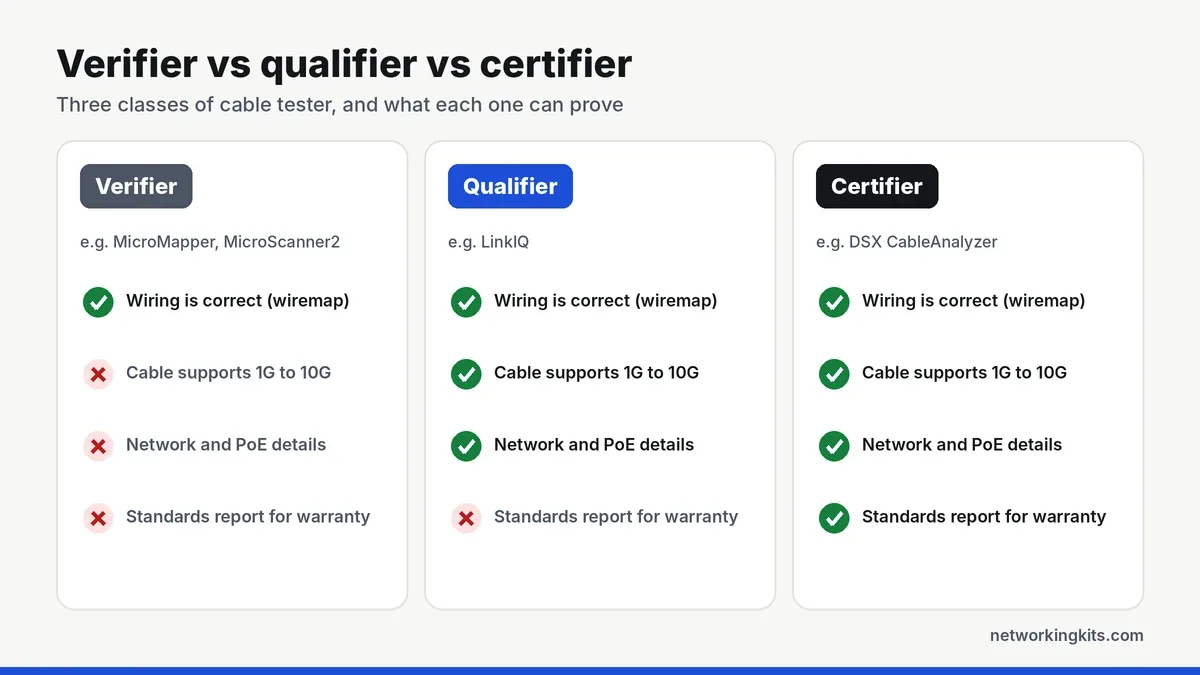
Most homes and small offices only need a verifier. Contractors handing cable over to a client usually want a qualifier. Certification is for large commercial projects where a warranty depends on it. Planning a new run? Our comparison of Cat6 and Cat6A cable explains which category a 10 Gigabit result really needs.
Reading a wiremap without guessing
Every tester here shows a wiremap, and four faults cover most of what you will see. An open is a broken or missing connection. A short is two wires touching. A crossed or reversed pair means wires landed on the wrong pins.
The split pair is the sneaky one. Every pin connects end to end, so a cheap continuity tester shows a pass. But the wires come from two different twisted pairs, and the cable loses much of its resistance to interference.
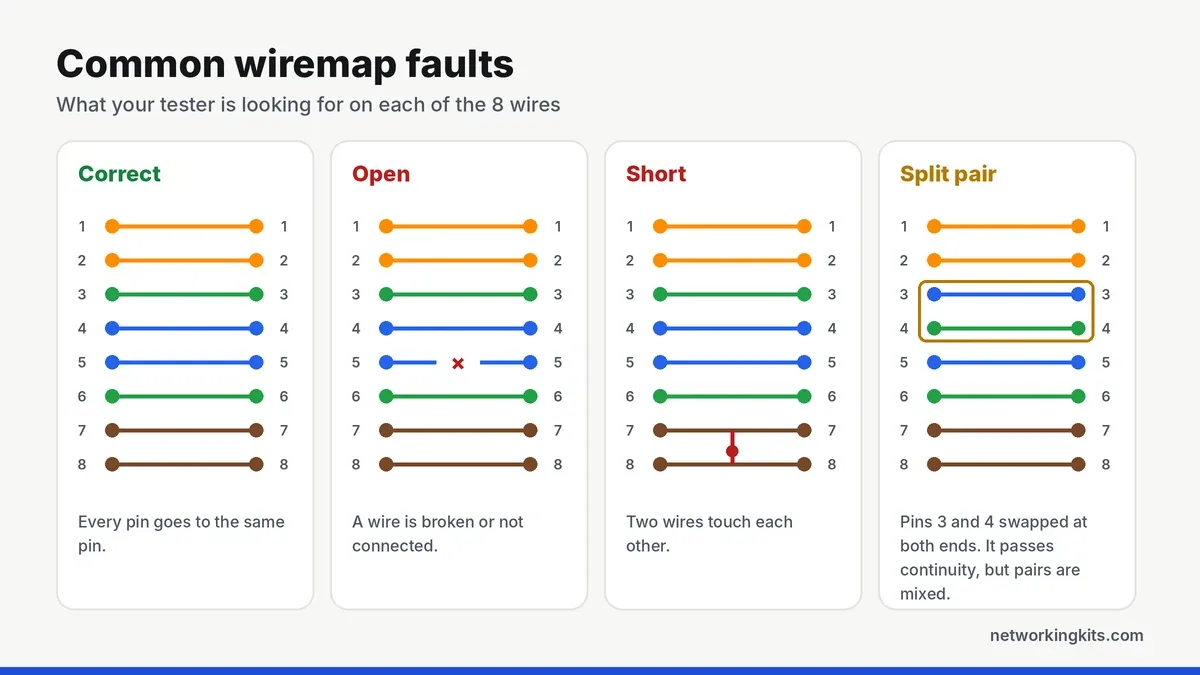
Many crossed pairs trace back to one end wired T568A and the other T568B. Our guide to the two Ethernet wiring standards shows both color orders side by side.
Tracing cables: filtered or unfiltered probe?
A tone generator and probe tell you which cable at the patch panel goes to which wall jack. The LinkIQ Kit and the MS2-KIT both include an IntelliTone Pro 200 probe. The MicroMapper has a tone generator built in that works with an analog probe.
The probe type matters more than people expect. An unfiltered probe is fine on dead cable, but on a live Ethernet run it also hears the network signal as noise. A filtered probe blocks that noise, so the tone stays clear even when the cable is plugged into a switch.
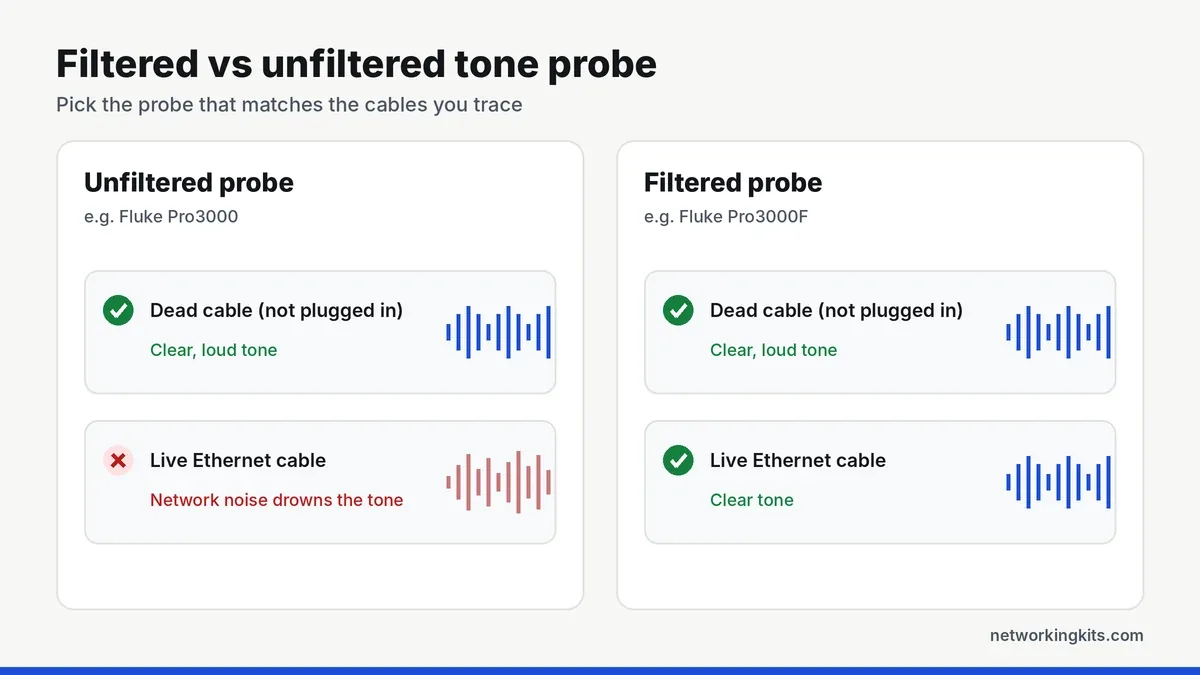
Label both ends of a cable the moment it passes. The tester proves the run is good today. The label saves the next technician from toning it all over again in five years.
When PoE is the real problem
Cameras, access points and VoIP phones all draw power over the cable. A device that boots, runs for a minute and then restarts is a classic sign the switch cannot deliver enough. LinkIQ and LinkIQ-Duo read the PoE class the switch offers, from Class 0 up to Class 8 (90 watts). Then they apply a real load to confirm the power is really there.
The MicroScanner2 can detect a basic 802.3af PoE source but does not load-test it. The MicroMapper does not check power at all. New to the topic? Our explainer on how Power over Ethernet works covers the classes and wattages.
Remote IDs: the quiet time saver
Remote IDs are small numbered plugs. Drop one into each wall jack in a room, walk back to the panel, and the tester tells you which remote each cable reaches. You can test and label a whole room in one trip. The LinkIQ Kit and the MS2-KIT both include a numbered set, which is a big reason we favor the kits over bare testers.
Spend where the time goes
Fluke prices are high, and Amazon listings can vary a lot between sellers, so compare before you buy. If cabling is your living, a qualifier pays for itself the first time it saves a return visit. If you terminate a few jacks a year, a verifier is plenty.
Either way, you will spend more time with a crimper and a punch down tool than with the tester. Our reviews of the RJ45 crimpers worth owning and the best punch down tools for Cat6 jacks cover the rest of the bag.
Final verdict
For most professional work, the Fluke Networks LinkIQ Kit is the best Fluke network cable tester to buy. It tells you if a cable is good and whether the network behind it is working, all in one test. The kit also includes the tone probe and remote IDs you would end up buying anyway, which makes it great value for installers and IT teams. It is quick to learn, and test results can be saved and turned into reports to share with a client or your team.
If you mount Wi-Fi access points as well, the LinkIQ-Duo adds wireless tools to the same visit. For simple wiremap checks at home or in a small office, the MicroMapper does the job for far less. The MicroScanner2 Kit is still worth considering if you test phone lines and coax as well as Ethernet. Just remember these are qualification testers, so a job that needs a formal certification report calls for a Fluke DSX.
Frequently Asked Questions
Is the Fluke LinkIQ a cable certifier?
No. LinkIQ is a qualifier. It measures whether a cable can support speeds up to 10GBASE-T and checks wiremap, length and faults, but it does not produce the full TIA or ISO certification reports some cable manufacturers require for warranties. For those you need a certifier such as the Fluke DSX CableAnalyzer series.
What is the difference between LinkIQ and LinkIQ-Duo?
Both qualify cable up to 10GBASE-T, show wiremap and distance to fault, read switch details and load-test PoE up to Class 8. LinkIQ-Duo adds Wi-Fi analysis and connection testing on 2.4, 5 and 6 GHz up to Wi-Fi 6E, plus a large color touchscreen.
What is a split pair and why does it matter?
A split pair happens when every pin connects end to end, but two of the wires come from different twisted pairs. A basic continuity tester shows the cable as good, yet it can cause slow speeds and dropped connections. The MicroMapper, MicroScanner2 and LinkIQ all detect split pairs.
What warranty do Fluke Networks testers come with?
Fluke Networks covers the main tester for 1 year from purchase, while parts and accessories have shorter cover. Fluke also sells optional support plans for longer protection. Buying from an authorized seller makes any claim easier.
Do I need a Fluke tester for home networking?
Usually not. For a few cables at home, an affordable wiremap tester does the job. A Fluke is worth it if you test cable often, need to find where a fault is, or want to check PoE and switch details. The MicroMapper is the easiest entry point if you want the Fluke name for less.
Tell us a little about your home or office network and we will point you in the right direction. We read every message.

We are network installers and home lab builders who have spent over a decade crimping, punching down and testing cable. Every guide is built from spec sheets, verified buyer feedback and real-world install experience.
How we research and score products →